Walk into any card room anywhere in the world, and you’ll find the same game: Texas Hold’em. It’s the most popular form of poker now by far, and has been for years.
Cash games, tournament poker, championship matches, big events… games big and small are overwhelmingly dominated by Hold’em. If you’re under 40, this is what you think of when someone says “poker.”
But it wasn’t always that way.
“Old School” Poker
Long before there was Hold’em, if a person asked you to play poker, they probably meant five-card draw. It was a simple game that even kids could play when gambling for Skittles. You got five cards, decided which to discard for fresh cards, and then played a single round of betting. Seven-card stud was also around. It was for more serious players, was more complex, and offered a bit more room for skillful maneuvers.
The games weren’t perfect. Draw poker gave players very little info about opponent holdings. Stud had more transparency, but neither one could build the tension in the right way. And with capped betting, the stakes were always manageable. Very few hands ended in drama or opponents sweating bullets.
Texas Hold’em came along and filled a gap many players never even knew existed.
Robstown and the Birth of a Game
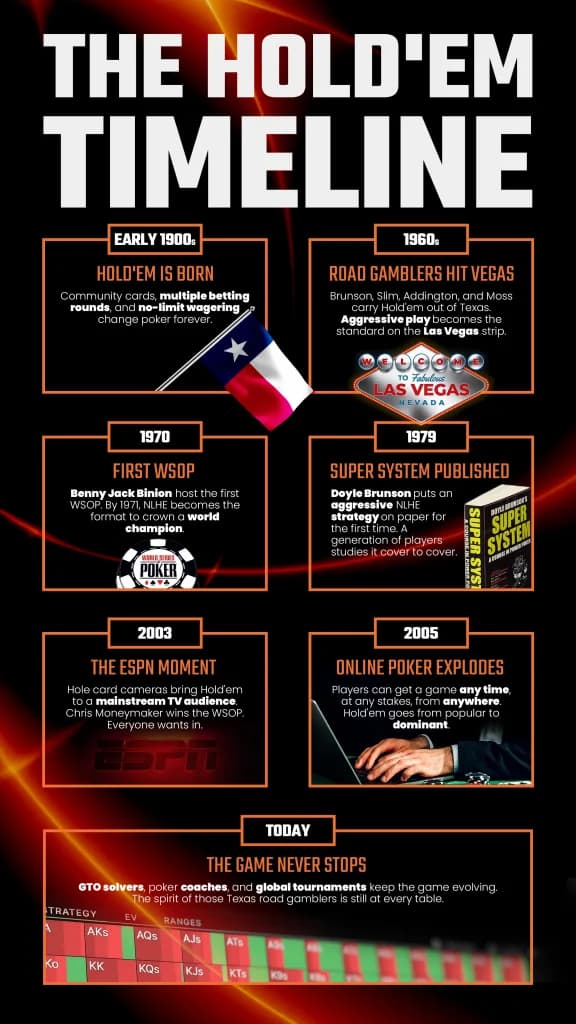
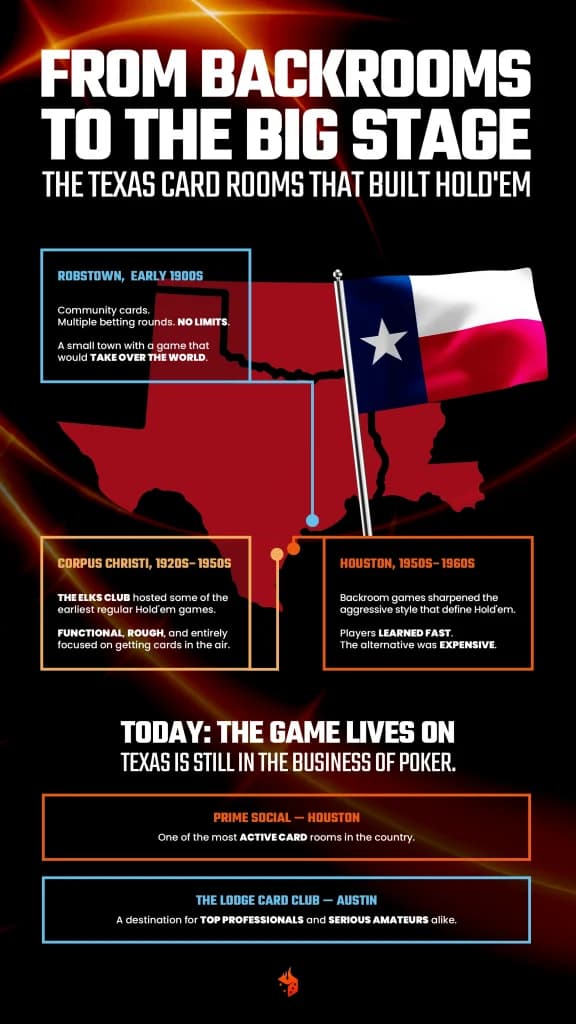
The origin story of Texas Hold’em is centered on Robstown, a small town in the southern part of Texas, not far from Corpus Christi. It evolved in the early 1900s, one feature at a time. Some credit a local gambler named Blondie Forbes with formalizing the rules around 1925, though the exact origins remain part of the game’s legend.
Community cards were among the biggest innovations. Instead of keeping all cards hidden, players share a board of face-up cards while protecting two hole cards of their own. That one change opened up the game entirely. Opponents could now make educated guesses about each other’s hands, but still had to read betting behavior to fill in the gaps. Add multiple rounds of betting to that, and suddenly every hand became a layered contest of information and nerve.
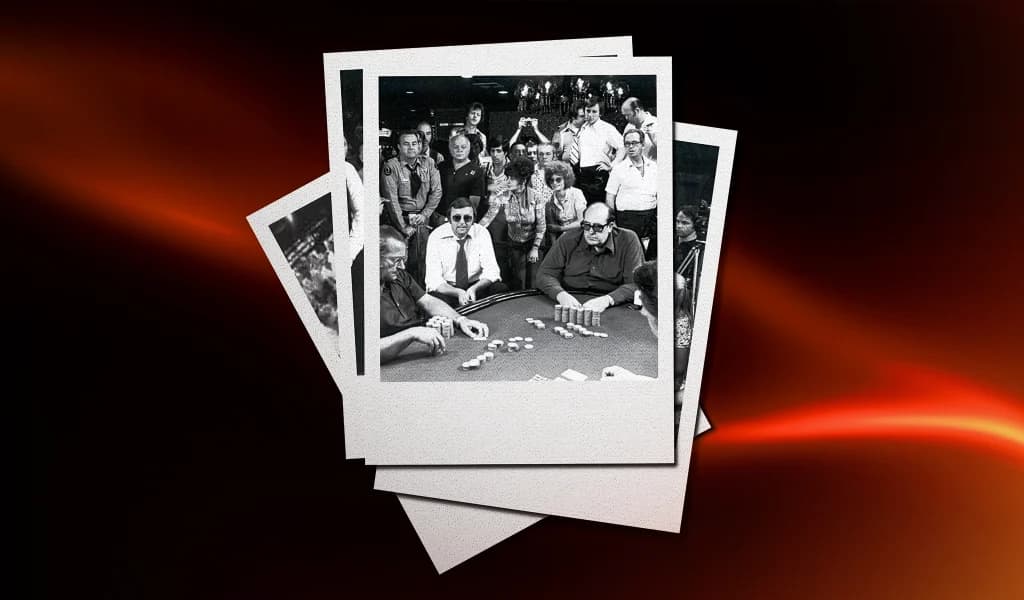
That was linked to another major step in the evolution of the game. Instead of a single round of betting, Texas Hold’em allows a hand to take shape over successive rounds of checks, bets, calls, and raises. This is what really allows players to sink their teeth into the analysis of a hand and what opponents are hiding behind their two hole cards. It could be a lot, or it could be nothing at all. And the only way to find out is to survive a showdown and pay for the pleasure of flipping someone’s cards over.
The game that took shape wasn’t a casual parlor game. It made money move, and fast. This was the final feature that really brought Hold’em to the next level. For No Limit Hold’em (NLHE), betting was uncapped. A player might shove all their chips toward the center at any given moment, which might put an opponent in a very hard decision. It could be an incredibly powerful bluff that leads to an even more impressive hero call. Or it could be someone with “the nuts” (the best possible hand for a particular round of poker), maximizing their gains.
More than anything, it was a pressure cooker. The game rewarded composure, sharp thinking, and the nerve to put everything on the line.
Texas Gamblers Take to the Road
In truth, Robstown just wasn’t big enough for Texas Hold’em. The game moved fast, carried town to town by a network of road gamblers who went wherever the action was. Road gamblers would roll into town in search of a back room, private home, or bar that would serve as a suitable environment to put cards in the air and money on the table.
It wasn’t big yet, but Hold’em was growing as people agreed to give it a shot. No man at a table wants to seem like a coward, so there was little opportunity to say “no” to a game as gutsy as this. The problem for casuals was that the sharks were circling, and Texas was full of fish who didn’t know it yet.
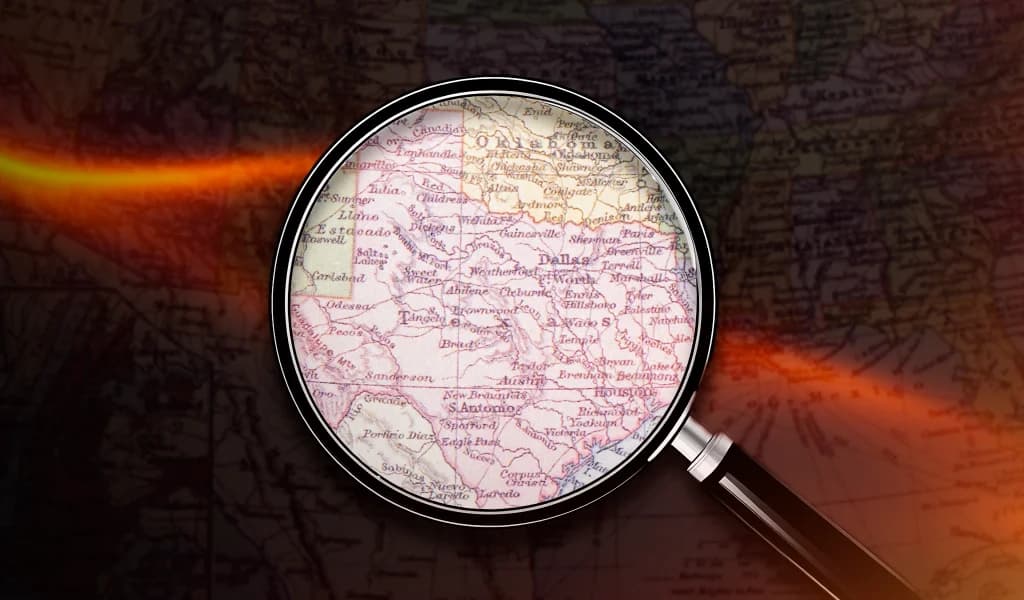
Names like Doyle Brunson, Amarillo Slim, Sailor Roberts, and Crandell Addington were all made in these early days. These folks didn’t learn poker at large casinos. They put it together one hand at a time across the towns and cities of Texas, where reputations were built the old-fashioned way.
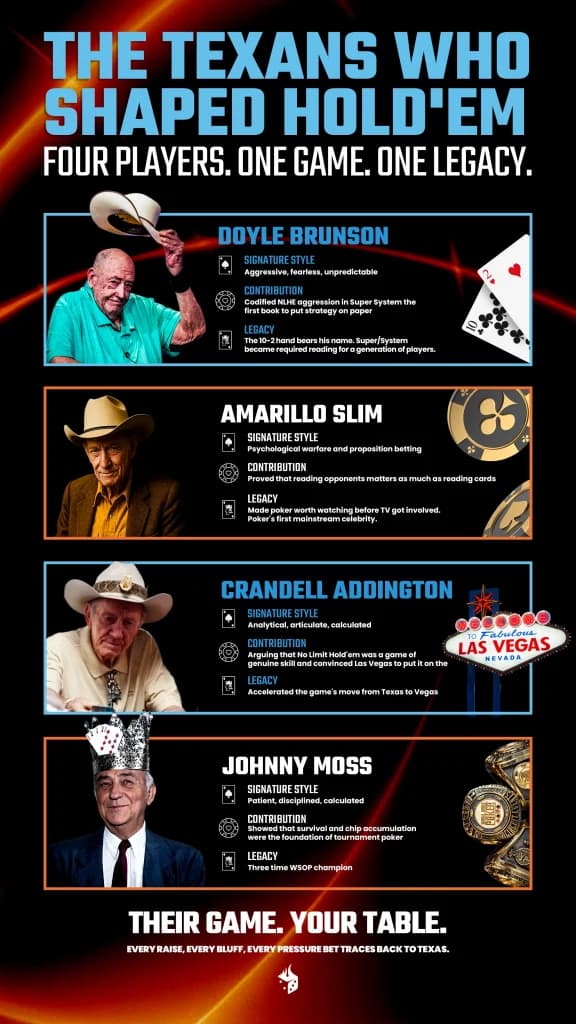
Brunson codified aggressive NLHE strategy in Super/System, published in 1979, a book so influential it became required reading for serious players. Amarillo Slim brought psychological warfare to the table and made poker worth watching. Crandell Addington was the one who convinced Las Vegas that No Limit Hold’em belonged on the floor. And Johnny Moss, a three-time WSOP champion, set the template for disciplined tournament play that players still follow today. Between them, these four men didn’t just play the game. They defined how it would be played.
Hold’em was great for these nomads. They could put the screws to casuals and have them under tremendous pressure. They could push people off their hands, even if they were decent. Mistakes were costly, and Hold’em was more like a street fight than a board game.
The mix of freedom with the possibility to win big or go down in flames was the very essence of Texas, and that mindset would become the core identity of America’s favorite kind of poker.
The Texas Card Rooms That Built the Game
The road gamblers needed places to play, and Texas had plenty of them. The Elks Club in Corpus Christi was one of the earliest known venues where Hold’em was played regularly, sitting close enough to Robstown that the game’s roots ran deep there. These weren’t glamorous spots. They were functional, sometimes rough, and entirely focused on one thing: getting cards in the air.
As the game spread, so did the venues. Backroom games in Houston and Dallas drew serious players and helped sharpen the aggressive, pressure-heavy style that would define Texas Hold’em for generations. The players who came up in these rooms learned fast because the alternative was expensive.
That culture never fully disappeared. Today, Texas has seen a resurgence of serious poker venues. Prime Social in Houston and The Lodge Card Club in Austin have become two of the most talked-about card rooms in the country, attracting top professionals and serious amateurs alike. The state that invented the game is still very much in the business of playing it.
How Texas Hold’em Arrived in Vegas
Not content with their Texas takeover, the road gamblers found themselves eventually drawn in the mid 1960s to Las Vegas. The poker rooms then mostly featured Draw and Stud. Hold’em was known, but it wasn’t an established mainstay just yet. The Texans would change all that.
At first, the casinos were hesitant. But after they saw how much action NLHE would generate, it piqued the interest of gaming executives. Hold’em had actually made its first Vegas appearance in 1963 at the California Club, introduced by Corky McCorquodale. But it was the Golden Nugget and the players it attracted that really put the game on the map. Big players, big games, and big pots all led to lots of bystanders flocking around the tables. The game from Texas established a hold during this period, and it would never let go.
The World Series of Poker
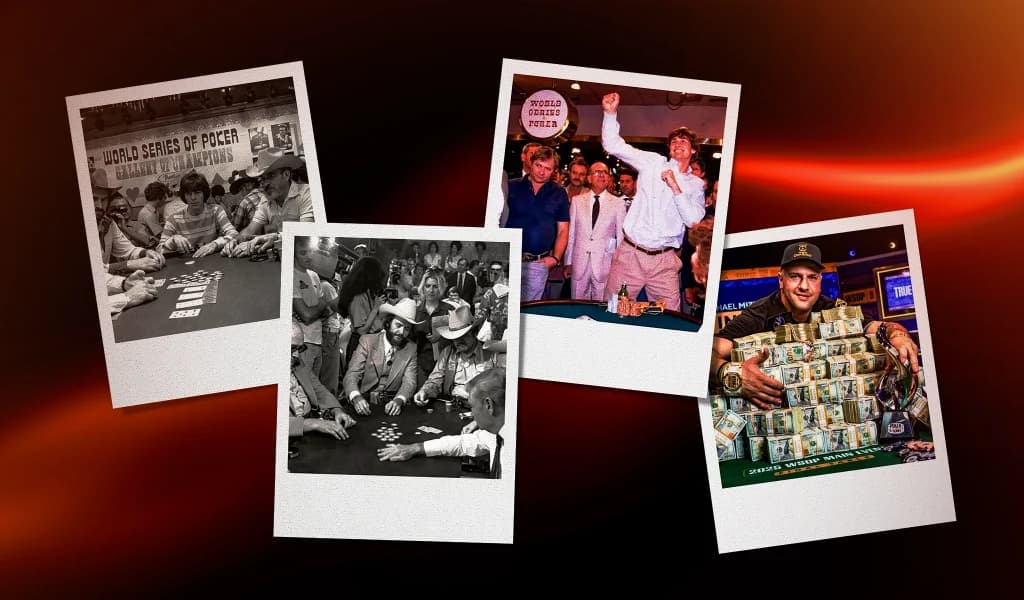
The World Series of Poker needed a proper format to crown a champion. Benny and Jack Binion solved that problem at their famous Horseshoe casino, hosting a small, invite-only gathering where the players themselves voted on the winner. By 1971, NLHE had become the format used to crown a champion at the Main Event final table, and that decision would shape poker forever.
The game became quite exciting, too. Players could bet everything at any moment. There was drama, hard decisions, and a compelling competition that spectators could really plug into.
The first champs were familiar faces. Johnny Moss took the inaugural title, and Doyle ‘Texas Dolly’ Brunson would follow.
What is Texas Style Poker?
The game naturally led to a certain playstyle. A Texas Hold’em winner was known to be aggressive, fearless, and ready to risk it all and gamble at any time. People played monster pots that had to be seen to be believed. When most folks were familiar with ten-dollar home games, the idea that a hundred grand could change hands in a single round of poker was preposterous and captivating. NLHE titans played huge pots, bluffed insane spots, and seemed to have no fear of going broke.
And that became the known character of the game.
NLHE rewards pressure and punishes hesitation. It’s not OK to sit around and wait for perfect cards to show up. Players, especially tournament players, have to make some moves with imperfect cards and incomplete information – consequences be damned.
Many ideas are now pretty standard, but back then, they were part of the Texas playstyle. A continuation bet, for example, was a way to follow up on preflop strength in an effort to force folds or at least retain control of the hand. NLHE required people to play the cards, but to “play the player” just as readily. This really separated the new game from what had come before.
ESPN and the Poker Boom

For decades, it was still the serious players who were focused on Hold’em. But then in 2003, ESPN brought the WSOP to a mainstream audience for the first time, complete with hole card cameras. This made it so much more accessible to follow the hands and players’ strategies. It opened up the game so that a whole new generation of card players could get on board. Chris Moneymaker, one of the biggest “normal person” poker champs the world had ever seen, had qualified for the tournament online for just $40. He won it all and became an overnight sensation. And what was more important: everyone could relate to him and could envision themselves doing what he did. NLHE had its hooks in millions of men and women after that.
Right alongside this new visibility and attention came the rise of the Internet. People could play poker for money online any time they wanted to at online casinos. It was a revelation. Now, there was always a game, and people could play for any stakes they liked.
With these two factors providing the perfect storm, Texas Hold’em went from a niche game to a global phenomenon almost overnight.
Strategy Evolves
Now, the game had tons of new players. The race was on to figure out how to get an edge over the splashy recreational players who knew little strategy, but who were always game to raise it. People were also trying to figure out what to do about the tight nits who wouldn’t ever play unless they had the goods. And then there were the killers – the guys who poured on the pressure and made you sick to your stomach when you had to play them at a final table.
Books like Caro’s Book of Poker Tells and Brunson’s Super/System became bestsellers. Movies like Rounders became so well known that many home games had to ban quoting the movie (just to get a break from hearing everyone’s terrible impersonation of Teddy KGB again and again).
As more players entered the game, the strategy changed.
Early Hold’em was a straightforward game. Players relied on feel and instinct to figure out if someone had a strong hand or a weak one. But this era didn’t last long. Reliance on math and probability soon became standard practice. Starting hand charts had to be memorized. Odds to make an open-ended straight or complete a four-flush draw on the turn had to be tattooed on a player’s heart to make snap decisions. Expected value, pot odds… a wealth of new vocabulary entered the poker lexicon.
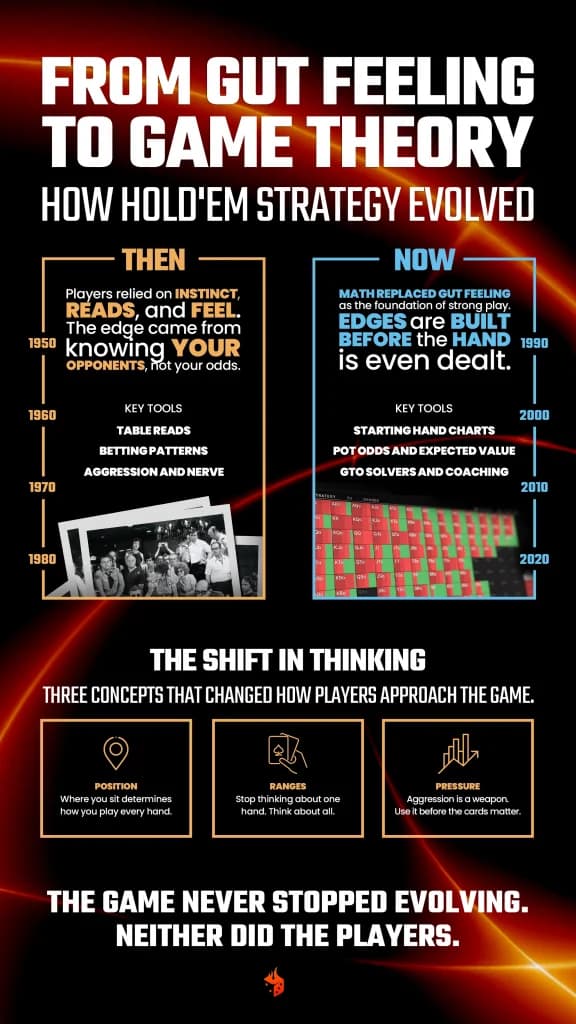
Online poker made everything move faster. Early sites even allowed players to track each other and analyze the performance of opponents. (Ignition Casino removes that advantage, creating a more level playing field.) Strategy was rapidly evolving as the arms race between players escalated year after year. Today, poker coaches, GTO concepts, and solver-based analysis have turned many players into formidable opponents.
The traditional core features are still there, though.
You still need to have a read on your opponents, be ready to apply pressure, and be flexible enough to get out of the way of a freight train that comes into the station on the river. Great players are blending both worlds – old and new – and the game still continues to develop.

Why Hold’em Won
Hold’em won for a few reasons.
The first is that it’s not that hard to learn. If you can understand a hand rankings chart, you can understand a round of Hold’em. The basic mechanics of betting order, checks and calls, and showing down can all be learned in a short session of poker. It’s mastery that is hard. Learning how to beat skilled opponents is no easy task. People have been playing for decades at this point, and you must fear and respect the player who has seen thousands and thousands of hands.
It offers deep strategic complexity for players who want to improve. There are tons of nuances to learn once you’ve got the basics down. You can figure out which hands to play to surprise opponents from each position. You can learn what each bet communicates, and how to vary your play with the occasional light 3-bet. And you can get a sense of ranges and how each hand will play out, even when multi-way.
There’s so much to consider that people who enjoy deep strategy and complexity will always have a blast playing NLHE.
And then there’s the excitement. Few games can match the drama of NLHE and the WSOP. At any moment, someone’s tournament life may be on the line, and that creates an edge-of-your-seat feeling that you rarely get, even when watching the finals of a major league sport.
Hold’em is also so accessible. With a few clicks, you can make it to your own final table. You can get a game whenever you want one. Hold’em scratches the itch perfectly, and that’s why it remains the “Cadillac of Poker.”
The Texas road gamblers may be fading, but anywhere five community cards hit the felt, their spirit is alive and well.