Once upon a time, playing poker meant playing five-card draw or maybe stud. Neighborhood dads would ante up in the basement for nickels and dimes while smoking cheap cigars and drinking beer. It was a classic American pastime.
Then, in 2003, it was hit with a bolt of lightning straight from above.
Poker went from a backroom game to a global sensation and the casino activity that would power the launch of online gambling. It was glitzy, complete with ESPN specials, magazine covers, celebrities at the felt, and millions of new players suddenly convinced they could go pro.
What was behind this explosion of popularity, and why did it happen then? Let’s take a closer look at the poker boom and its lasting legacy.
The Bluff Heard Round the World
In May 2003, an amateur player from Tennessee named Chris Moneymaker was having fun with poker online. He entered an $86 satellite tournament and won, earning a ticket to something few outside of Vegas and hardcore poker lovers had ever heard of: the World Series of Poker.
The $10,000 buy-in Main Event brought out all the card sharks and wealthy card players, but the average joe was generally unaware of it. That was all about to change. Moneymaker went on a historic run as ESPN’s cameras rolled.
While ESPN had the WSOP broadcast rights for most of the 90s, they had recently reacquired them in 2002, adding one crucial element: hole card cameras. This new perspective gave fans a look at what players were holding, giving them unprecedented visibility into the action on the felt.
Moneymaker, playing in his first live tournament ever, went on to knock out the legendary Phil Ivey along the way. He then famously faced Sammy Farha and put it all on the line with king high. Farha folded (against his better judgment) and Moneymaker went on to scoop $2.5 million, the world championship, and the last classic gold bracelet made by long-term WSOP jeweler Mordechai Yerushalmi.
It wasn’t just that an amateur won. It’s that he won on camera in spectacular fashion, and viewers at home could see exactly how he did it. Poker was on the world stage and it sparked an interest that wouldn’t be forgotten.
The Camera That Changed Everything

No matter what, Moneymaker’s win is a great story. But what turned poker into a boom (at least in part) was the new view into the players’ hands.
In 1995, inventor and part-time poker pro Henry Orenstein patented the hole-card camera. It was simple; just a tiny lens embedded under the rail of the poker table. It debuted quietly on British television in 1999, made its way to ESPN’s WSOP coverage in 2002, and was ready to roll by the time Moneymaker sat down in 2003 for his legendary run.
For the first time, poker was watchable the way a heist movie is watchable. The audience knew things the players at the table didn’t, and every move had so much dramatic tension.
Also, the timing could not have been better. The Internet was booming right alongside poker. There was an explosion of online poker sites and finally anyone could play. You didn’t have to be in reach of a cardroom. You didn’t have to brave the smoke and the traffic and the regulars. Anyone with a credit card could create an account, make a deposit, and be playing poker within a few days.
Thanks to Moneymaker’s win, many believe that there was a path straight to the top. The “Moneymaker Effect,” combined with the Internet boom, skyrocketed poker to places it had never been before. The World Poker Tour was on the Travel Channel. Rounders was on cable. And everybody with a computer was ready to go all in.
The Numbers Tell the Story
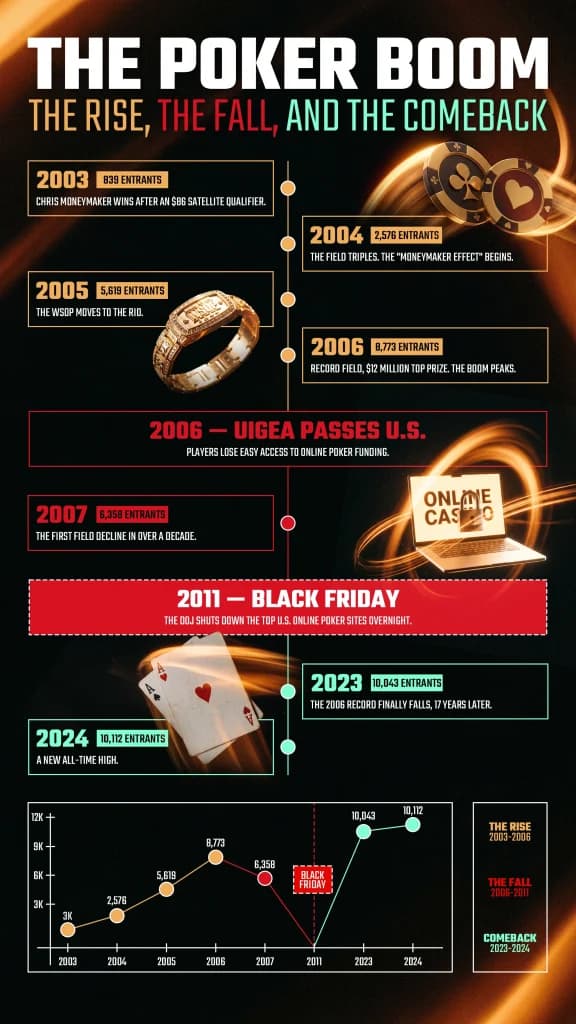
The WSOP Main Event field size really tells the story. In 2003, there were less than 1,000 entrants; the next year, 2,576 card players tried their luck at the Horseshoe. In 2005, a few thousand more joined in the fun, and the field reached 5,619.
By 2006, it ballooned to 8,773 hopefuls. First place now offered a prize of $12 million. People who qualified through satellites now made up a huge chunk of those at the WSOP. Online poker sites would send a duffel bag of cash to Vegas to cover buy ins.
Satellite winners and newly sponsored amateurs would receive their branded shirts and hats minutes before they sat down in front of the cameras to play. Like 49ers in the gold rush, everyone scrambled to capitalize on the cresting wave of poker madness.

A New Kind of Celebrity
The boom didn’t just create new players. It created new stars.
These famous poker players didn’t look anything like ol’ “Texas Dolly” Doyle Brunson. They weren’t grizzled road gamblers.
Instead, we had Greg “Fossilman” Raymer, a patent attorney who won in 2004 wearing novelty lizard sunglasses. There was Joe Hachem, an Australian chiropractor, who took it down in 2005. The next year featured Jamie Gold, a Hollywood TV producer with no notable tournament résumé. He played his way through the largest field the WSOP had ever seen and won the 2006 title. New wave winners didn’t look at all like professional gamblers.
At the same time, a handful of very sharp professional players used the boom’s spotlight to become well-known poker celebrities.
Legends like Daniel Negreanu, Phil Hellmuth, and Phil Ivey all became recognizable names, landing magazine profiles and TV appearances that simply didn’t exist for poker pros before 2003.
An ecosystem came to life as professionals inked sponsorship deals, dealt with media obligations, and grew their fanbases. It was all sparked by the Moneymaker Effect and fueled by the ongoing year-to-year growth of online poker and the poker media industry.
The End of the Party
The poker boom was cut down in two major steps.
The first was the 2006 passage of the Unlawful Internet Gambling Enforcement Act (UIGEA), which made it a lot harder for U.S. players to move funds from their bank account or credit card to online casinos.
It didn’t outlaw playing poker itself, but shut down the ability to move money (and for poker sites to hand out WSOP seat packages to U.S. players). The 2007 Main Event field actually shrank for the first time in over a decade, and the number of entrants went down to 6,358.
Then came Black Friday.
In April 2011, the U.S. Department of Justice indicted the founders of the three biggest online poker sites and effectively shut down the American online poker market overnight. Player accounts were frozen and money wouldn’t be released for years. An entire generation of players, some whom had built full careers in poker, were punched right in the gut. The party was over, at least for the time being.

Twenty Years Later: The Legacy of the Poker Boom
If you’re thinking that the poker world has shrunk since the heyday of the poker boom, think again.
The 2006 WSOP Main Event hosted a record 8,773 players. This record was at long last broken in 2023, when the event saw 10,043 entrants. The WSOP topped this number the following year when 10,112 signed up for the big game. Poker’s not just alive and well, it’s thriving.
One major change, though, is how fans and players follow the game. Instead of ESPN specials and live coverage, high-stakes cash games are broadcast on streaming platforms. Online poker continues to grow, and it’s never been easier for players to get a seat at the digital table of their choice.
The legacy of the poker boom is the promise that anyone with a chip and a chair can go on an epic run and start a whole new chapter of their life at a poker table.
Anyone can learn the game. Anyone can play. And on the right night, anyone can win. Like that famous accountant from Tennessee, all you need to do is to forget to be intimidated by the table.