We’ve all been there. Your poker session is going great. Your decisions are sharp. You’re making disciplined folds and solid reads. You’ve managed to grind out some nice profits. And then things take a turn for the worse. It seems like you can’t catch a card to save your life. You start getting a bad feeling about your hands. Then, you get your money in good, and your opponent sucks out on you, leaving you cleaned out.
Back to the drawing board.
Poker variance can be a very challenging part of the game to master. It requires you to understand your emotions, avoid tilt, and accept that some sessions just aren’t going to go well. For the long-term players, they can have bad weeks, bad months, bad years, and even bad decades.
WSOP bracelet holder Gus Hansen’s public chart on HighStakesDB from 2007 to 2015 became famous for its brutal downward trajectory, showing over $20 million in losses. Even Daniel Negreanu, a six-time WSOP bracelet winner, posted a $1.1 million loss during his 2022 WSOP campaign, going the entire summer without reaching a single final table.
And so if even the great players can run bad, what are normal poker players to do? How can they understand variance and ride out the rough patches?
What is Poker Variance?
Variance is the gap between 1) what you’d expect to win based on the quality of your decisions and 2) what actually happens over any given stretch of hands. Poker rewards good decision-making over the long run, but in the short run, anything is possible.
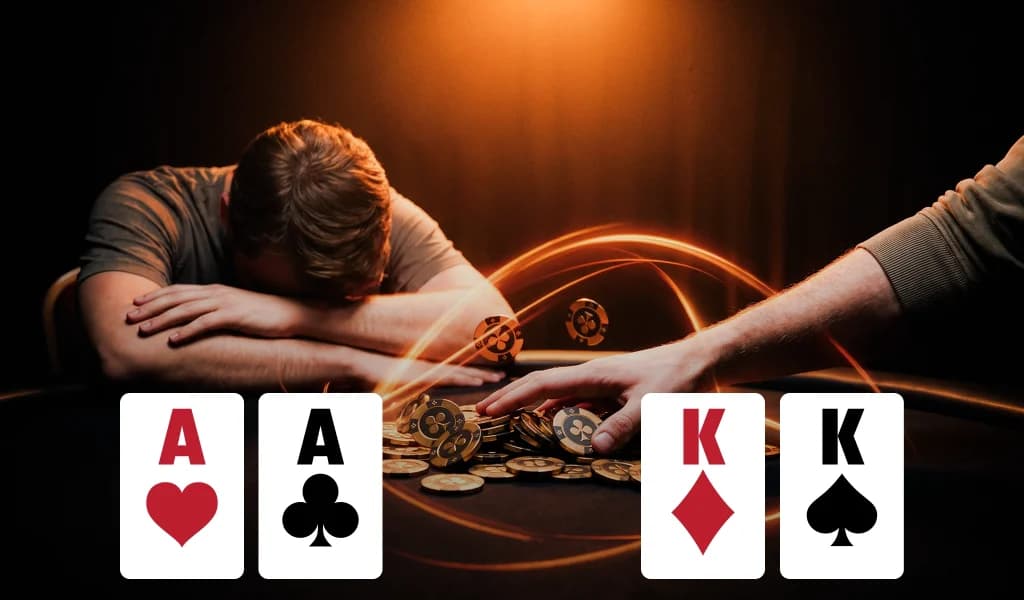
Betting on an 80%-favorable outcome can still lead to loss. When that happens back-to-back, you’re experiencing variance. For example, you can get your chips in with pocket aces against pocket kings and still lose. It doesn’t mean you made a bad decision. It just means that good decisions are no guarantee of a good outcome.
The Numbers Behind the Swings
Variance isn’t just a feeling. It’s measurable. In full-ring or 6-max No-Limit Hold’em, standard deviation typically runs between 70 and 100 big blinds per 100 hands. This means that, whatever your expected win rate is by the numbers, it can drift 70-100 BB away in either direction.
Tight, disciplined players tend to sit toward the lower end of that range, while looser, more aggressive players run closer to 100 or higher.
A solid player might expect to win only about 5 BB / 100 hands played. This means that there is a TON of movement in actual results off the expected number. Variance dwarfs the anticipated profit a good player is going to gain, and so it in many ways is the real enemy at the poker table, not the players across from you.
How does this work in practice? A winning player running at 5 big blinds of profit per 100 hands played, with an 80 big blind standard deviation, has roughly a 5% chance of hitting a 20-plus buy-in downswing at some point within any 100,000-hand stretch. You’re supposed to be up, but instead are down several times your expected profit. That’s the variance monster rearing his ugly head.
Why Variance Feels Bigger Than It Is
Research on randomness shows that people are naturally bad at recognizing independent, random sequences for what they are. We tend to see patterns and “momentum” where none exist. A string of bad beats feels like a sign of some kind. It might be a sign to take a break before tilt sets in, but the next hand knows nothing about the one that came before it. Players have to keep this in mind.
Cash Games vs. Tournaments: Different Flavors of Variance
Cash games
Variance in cash games tends to be the gentler version. Because you can sit down, play any stack size, and leave whenever you want, your results should be relatively smooth. Swings come and go, but they tend to follow a more manageable profile than tournaments do.
Tournaments
Only a fraction of the field gets paid in a poker tournament, with payouts weighted heavily toward the top finishers. For this reason, variance hits hard here. Buy in after buy in goes down the drain. A good tournament player can run 100 to 300 buy-ins below expectation in a given stretch, especially in larger fields. This doesn’t have anything to do with their real skill. And that’s why the standard bankroll recommendation for tournament players is to only buy in for a game that costs 2% of your bankroll or less.
How Experienced Players Keep Perspective
Top poker players have a few ways to handle the challenge of variance.
- They judge decisions, not results. After a session, they can live with the result so long as they made good decisions. Winning or losing is secondary.
- They track the right numbers over the right sample. They don’t worry about a particular session. They track results over the long term, where skill actually has room to show up in profits.
- They separate bankroll from ego. A downswing tests your bankroll and your composure. Good players avoid tilt and they definitely don’t move up in stakes to chase losses.
- They expect the downswing. Elite players know that a long stretch of losing hands or busted tournaments is well within normal variance. They accept it, expect it, and move on.
The Bottom Line
Variance is the reason poker can be simultaneously a game of skill and a game where the better player doesn’t always win. It’s what keeps the games soft enough for skilled players to have an edge, and it’s also what makes the mental side of poker just as important as the strategic side.
Both are important, and that’s why a resource like our Sit and Go strategy guide will break down the tight variance profile of short-handed tournament play and how to adjust your approach around it.
The next time a session goes sideways despite your best decisions, remember that the math was going to get rocky at some point. The only real mistake is letting a bad run convince you to abandon the smart decisions that made you a winner in the first place.